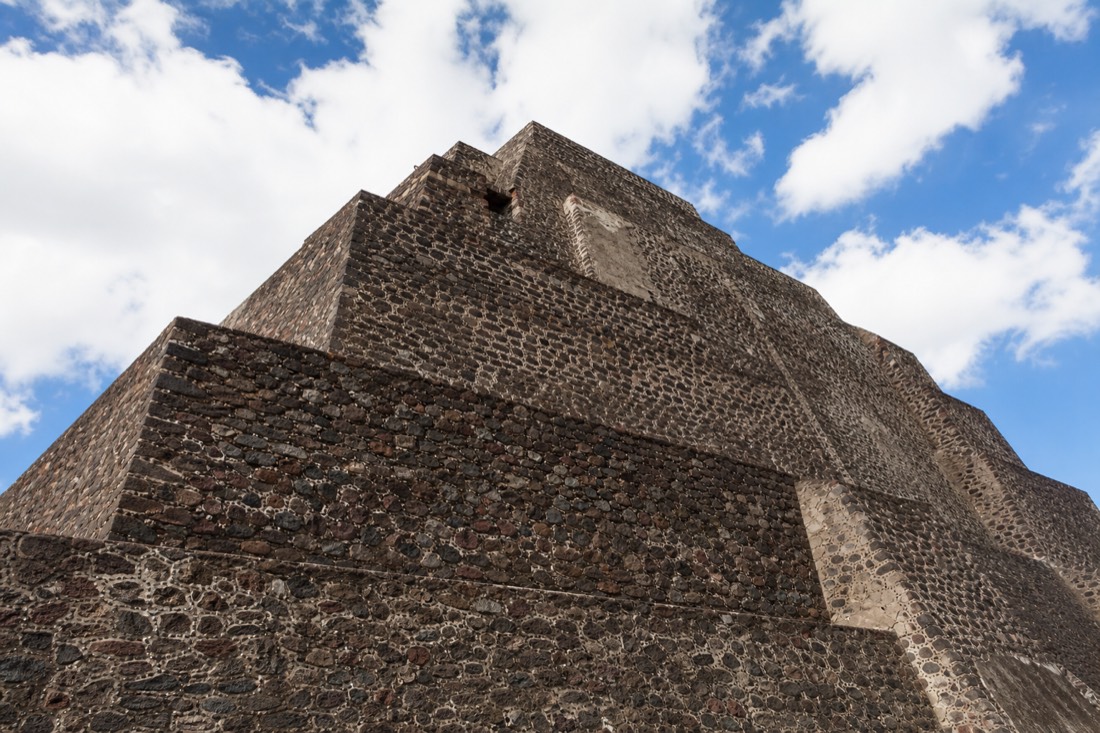
Teotihuacan or Chichén Itzá: which one should you actually visit?
Different civilisations, a thousand kilometres apart, and neither lets you climb any more. Which one to choose depends on where you already are and what you want out of the day.
 By Alejandro Ramírez, Teotihuacan hot air balloon specialist and experience guide
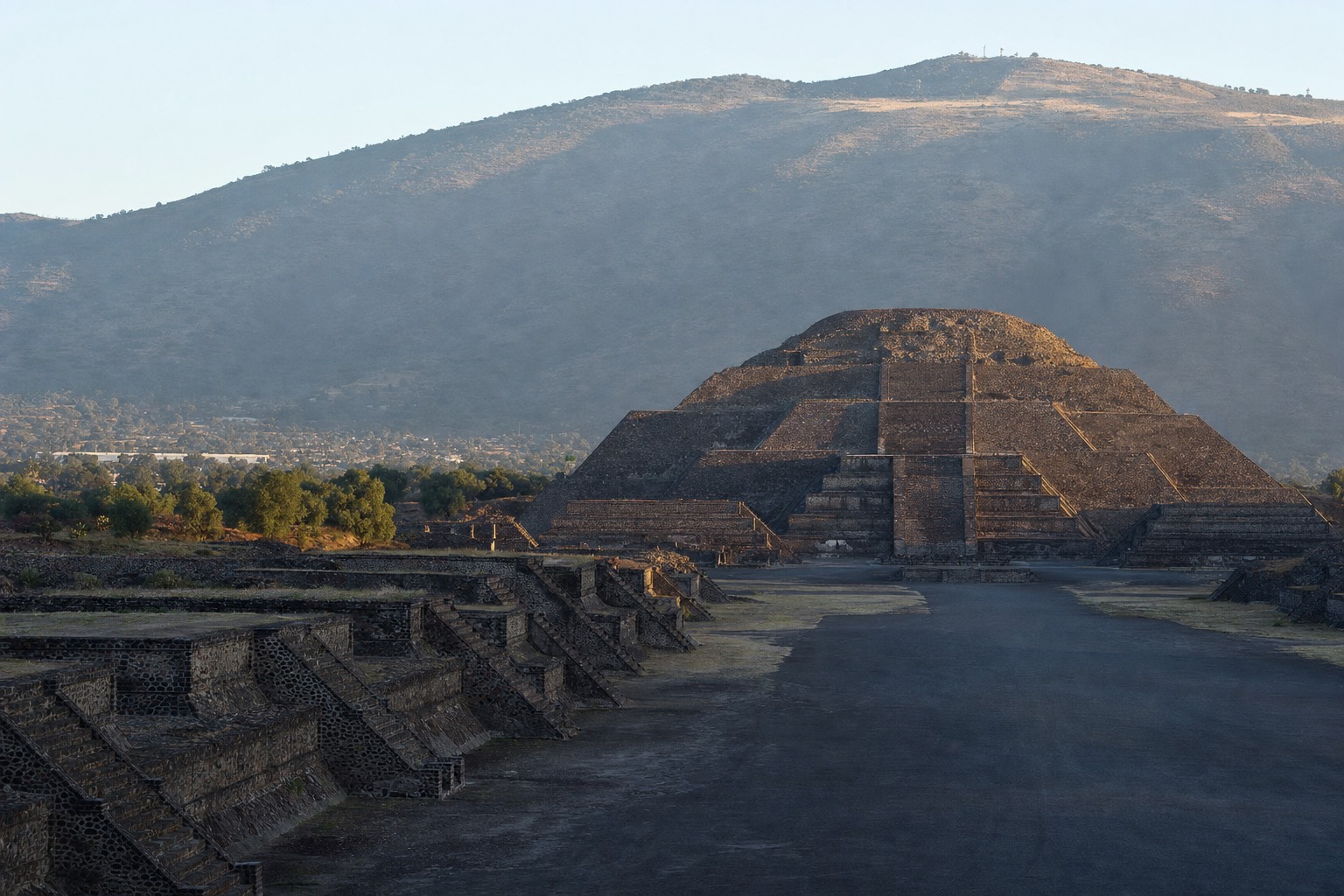
People treat this as a ranking question and it is really a logistics question. The two sites are about 1,300 km apart, belong to different civilisations separated by centuries, and serve completely different trips.
The straight comparison
| Teotihuacan | Chichén Itzá | |
|---|---|---|
| Where | 50 km from Mexico City, central highlands | Yucatán, near Valladolid, a couple of hours from Cancún or Mérida |
| Who built it | An unnamed civilisation, peaking 100 to 550 CE | Maya, with a major phase around 600 to 1200 CE |
| Signature structure | Pyramid of the Sun, 65 m | El Castillo, the stepped pyramid of Kukulcán |
| Scale | A whole planned city, two-kilometre avenue, residential districts | A ceremonial centre with famous individual buildings |
| Climbing | Not permitted | Not permitted |
| UNESCO | Inscribed 1987 | Inscribed 1988 |
| Entry | 210 MXN foreigners, 105 MXN nationals and residents, free Sundays for nationals | Higher, with a state fee on top of the federal one |
| Balloon flights over it | Yes, daily at sunrise | No |
| Crowds | Heavy, worst on Sundays and at the March equinox | Heavy, and heavier: it is on the New7Wonders list |
| Best for | Urban planning, scale, the aerial view | Maya astronomy, the ball court, the cenote |
What each one is actually good at
Teotihuacan is a city. That is the difference. You are not looking at a temple complex, you are walking through the plan of a metropolis: a ceremonial avenue two kilometres long, apartment compounds housing tens of thousands, a grid oriented off true north. Its power is scale and design, and both of those land hardest from above.
Chichén Itzá is a set of masterpieces. El Castillo, whose stairways produce the serpent-shadow at the equinox. The largest Mesoamerican ball court known. The Sacred Cenote. The observatory. Each of them is a finished, intelligible object in a way that Teotihuacan's structures, stripped of their plaster and paint, are not.
If you want to understand how an ancient city worked, Teotihuacan. If you want astronomy, ritual and Maya iconography you can read, Chichén Itzá.
The thing only one of them has
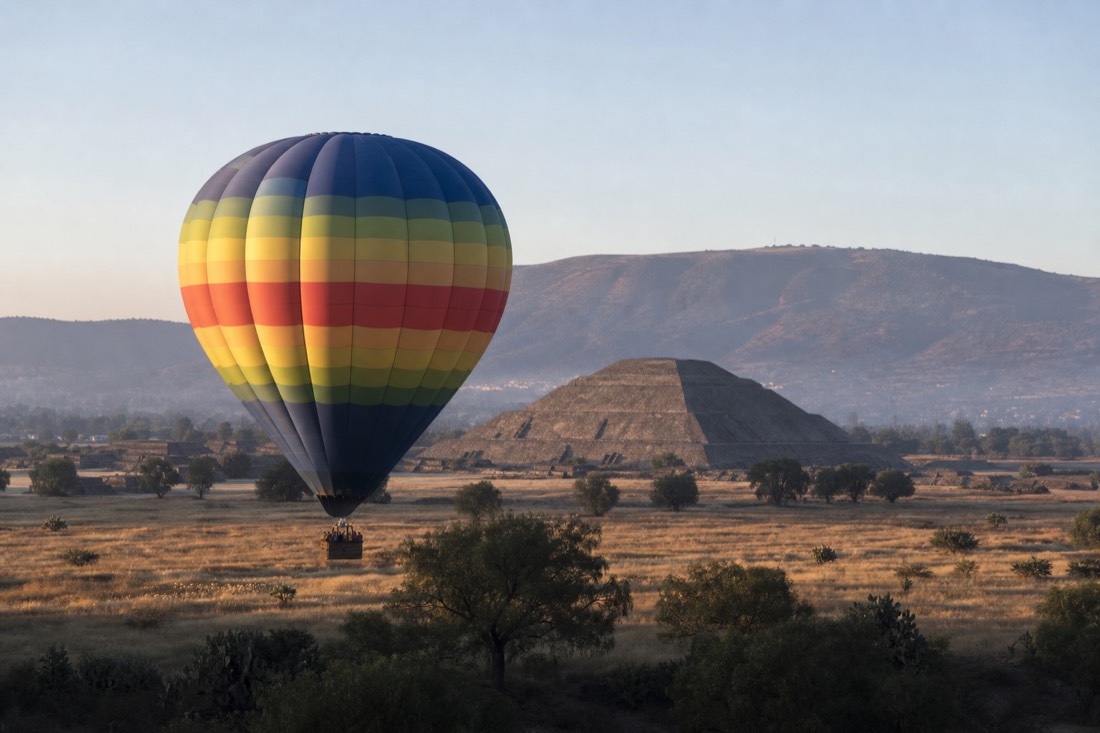
There are no balloons over Chichén Itzá. There are, daily at sunrise, over Teotihuacan.
That matters more than it sounds, because neither site lets you climb any more. At Chichén Itzá the elevated view is simply gone. At Teotihuacan it moved into the air, and since the site's whole significance is its layout, the aerial view is not a novelty add-on but arguably the correct way to see it. We set that out in what you actually see from the basket.
Which to do on which trip
Based in Mexico City? Teotihuacan, obviously. It is 50 km away and doable as a half day or as a dawn balloon morning. Getting to Chichén Itzá means an internal flight and at least a night in the Yucatán.
Based in Cancún, Playa or Tulum? Chichén Itzá, and consider Cobá or Ek Balam alongside it, which are quieter. Teotihuacan is a separate trip.
Doing both? Order them Teotihuacan first if you can. Seeing the older, larger planned city before the Maya ceremonial centre gives you the chronology in the right direction, and the influence Teotihuacan exerted across Mesoamerica makes more sense once you have stood in it.
Only one, and you have no fixed base? Teotihuacan, narrowly, and for a reason people do not usually give: Mexico City itself. The site pairs with the Museo Nacional de Antropología, which holds the finds and the context, and that pairing is the single best archaeology day in the country. Chichén Itzá pairs with a beach.
The crowd problem, which both share
Both sites are extremely busy and both have a worst day. At Teotihuacan it is Sunday, when entry is free for Mexican nationals and residents, plus the spring equinox in March. At Chichén Itzá it is also the equinox, when the serpent shadow draws enormous numbers.
The advantage of the balloon route at Teotihuacan is timing rather than access: you land around eight, the zone opens at eight, and the coaches from Mexico City arrive later. Being on the Avenue of the Dead at ten in the morning is a different experience from being there at one.
The honest verdict
They are not competing for the same slot in your trip and pretending they are wastes energy. Go to whichever one your geography puts within reach, give it more time than the tour operator suggests, and if it is Teotihuacan, decide separately whether the 4 a.m. version of the day is for you.
What the Teotihuacan side of the trip actually involves
If geography has already decided Teotihuacan for you, here is what commits you to what.
| Just the ruins | 210 MXN entry, a few hours, no advance booking needed for a weekday visit |
|---|---|
| Ruins plus the balloon | $159-$263 depending on package, a 4 a.m. start, and the whole day committed |
| Getting there | 50 km from Mexico City, about an hour by car, bus or tour van; no flight required, unlike reaching the Yucatán from most of Mexico |
| Reversibility | Easy to add or drop the balloon at short notice, since it is a separate booking from the ruins ticket |