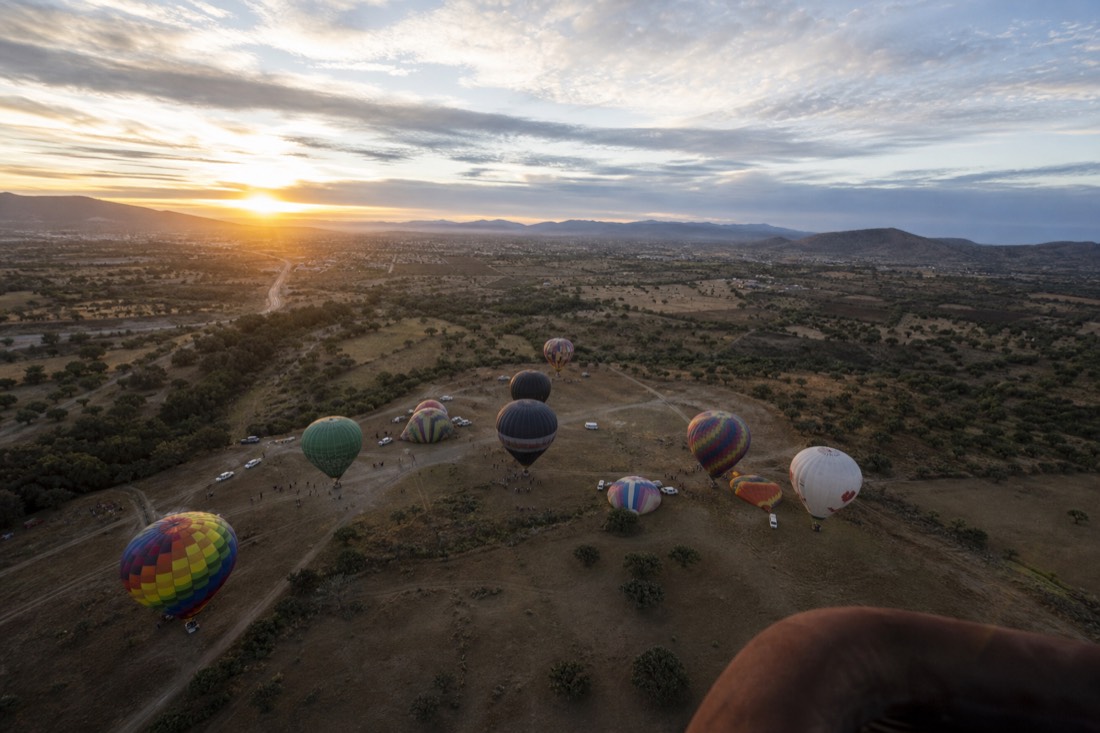
What you actually see from the basket
Not a pyramid from directly above. A two-kilometre avenue, two pyramids, a ring of mountains and low sun raking across the terraces. What is actually in front of you for 50 minutes.
 By Alejandro Ramírez, Teotihuacan hot air balloon specialist and experience guide
The photograph that sells these flights was taken from the ground. A long lens, a balloon two kilometres away, a pyramid behind it, and compression doing the rest. It is a beautiful and slightly dishonest image, and it sets an expectation the flight cannot meet.
Here is the actual view, which is different and better.
The moment the valley opens
Ascent is slow enough that there is no sense of rising, only of the ground getting further away. Because the balloon travels with the wind there is no wind in the basket: it is completely still, and after the noise of inflation the quiet is startling. The loudest thing is the burner, every twenty or thirty seconds, and then nothing.
What comes into view first is not a pyramid. It is the shape of the land. The Teotihuacan valley is a broad flat basin ringed by hills, with Cerro Gordo closing the northern end, and from a few hundred metres up you see immediately why somebody built a city here.
Then the plan
This is the thing worth flying for, and it is invisible from the ground.
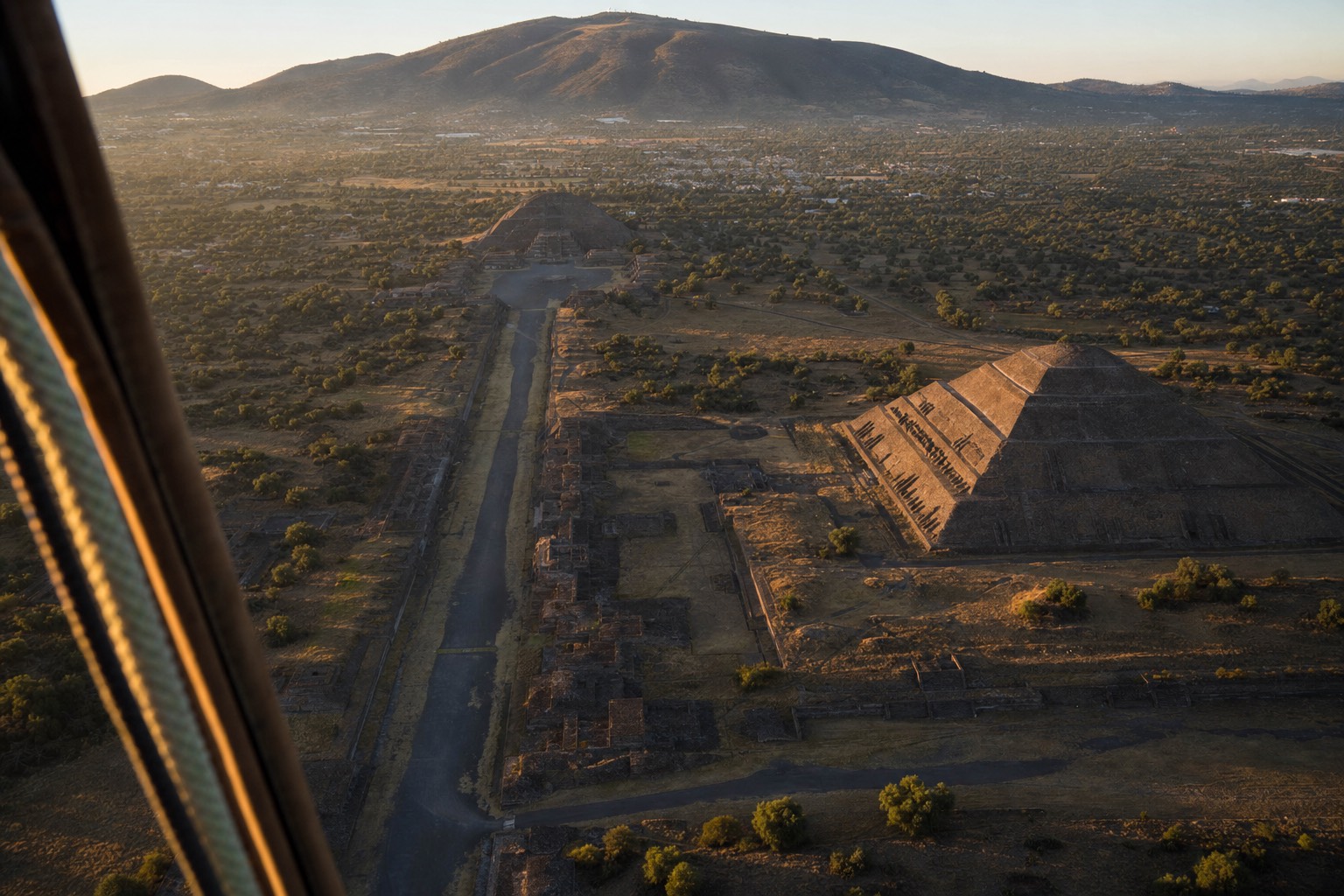
The Avenue of the Dead runs roughly two kilometres north to south. The Pyramid of the Moon sits at the northern end, closing the axis, with Cerro Gordo behind it echoing its silhouette. The Pyramid of the Sun is set off the eastern side, three-quarters of the way up. The Ciudadela, an enormous sunken enclosure holding the Temple of the Feathered Serpent, anchors the southern end.
Walk it and you experience a sequence of big things. Fly it and you see one design. That relationship, between the buildings and the mountains and each other, is the entire achievement of Teotihuacan, and it only assembles into sense from an angle and a height.
What the light does
Take-off is around 6:45, timed to first light, and the light is doing something specific. Low sun rakes across the terraces so every step edge and every platform throws a long shadow, and the pyramids read as stacked geometry rather than as brown mounds. An hour later, with the sun higher, they flatten out.
This is why a delayed launch stings. One traveller reported lifting off at 7:15 after waiting for wind and feeling they had missed the point of the hour. They were not wrong.
| What you see | Roughly when |
|---|---|
| The launch field, burners, envelopes going up in the dark | 6:00 to 6:45 |
| The valley floor, other balloons, the town waking up | First minutes after take-off |
| The Avenue of the Dead as a single axis, both pyramids in frame | The main part of the flight |
| Cerro Gordo behind the Pyramid of the Moon, and the shadow geometry | While the sun is still low |
| The chase vehicles tracking you across the fields | Toward the end |
What you do not see
You do not fly over the Pyramid of the Sun. Balloons launch from fields near San Martín de las Pirámides and go where the air goes, beside and around the zone rather than above it. A pilot can climb or descend to catch a different wind layer, and that is the whole steering repertoire, so nobody can commit to a position over a 65-metre building. The overflight guide goes through why in detail.
You also do not see it for very long. Thirty to sixty minutes total, and the pyramids are properly in frame for a portion of that. Set the expectation at "a spectacular half-hour" rather than "an hour of drifting over ruins" and you will come down happy.
The other balloons
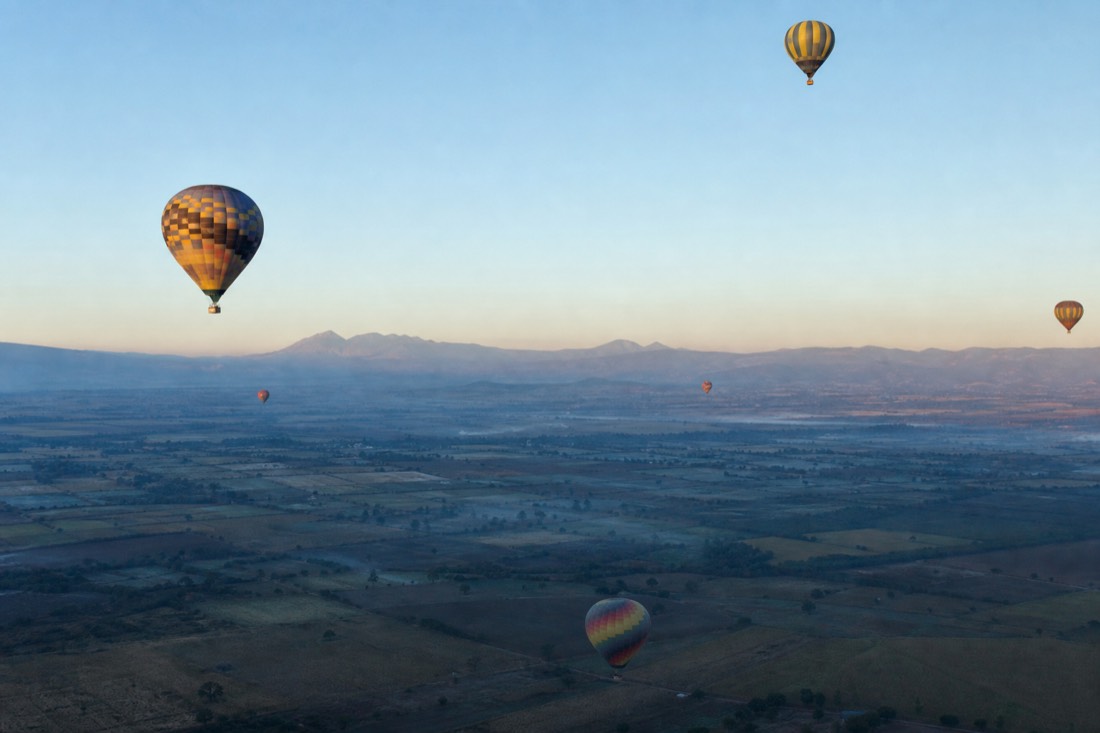
Nobody mentions this and it is half the pictures people take home. You are not up there alone. Multiple operators launch from the same fields within minutes of each other, so the sky fills with envelopes at different altitudes catching the first sun.
How many is a question we cannot answer, because no operator publishes a count and we are not going to invent one. What we can say is that the balloons themselves become a subject, and a shot of another balloon low over the valley with a pyramid behind it is the picture most people end up keeping.
Every operator launches within a few minutes of the others, so this part of the morning is the same whichever ticket you hold. What differs is the ground arrangements, which is why the flight with hotel pickup and the cave breakfast carries six times the review count of anything else on this valley.
Getting a photograph of any of it
Short version: you are in a shared compartment with a section of rail, standing, into a rising sun, while the basket rotates slowly on its own schedule. Phone on a wrist strap, one camera on a neck strap, nothing loose. We wrote out the specifics in photographing the pyramids from a balloon.
If getting the shot genuinely matters, this is one of the few real arguments for paying for a private basket, where you can move to whichever side the light is on.
Then the ground comes back
The descent is faster than the climb and the landing is the part first-timers underestimate. Knees bent, both hands on the handles, facing the direction of travel. The basket may bump, drag across a field, or tip onto its side while the envelope comes down and the chase crew grabs it.
That is normal, not a malfunction, and the safety guide explains why balloons land that way. Then there is a toast, a certificate, and the strange business of standing in an ordinary field at eight in the morning having just seen a two-thousand-year-old city assemble itself into sense.
What is visible at each stage
| On the ground, pre-dawn | Nothing of the site; just the launch field and the other balloons inflating |
|---|---|
| First minutes of ascent | The valley's shape, other balloons at different heights, the town waking up below |
| Mid-flight, full height | Both pyramids, the full Avenue of the Dead, the Ciudadela, the mountains ringing the valley |
| Descent | Ground detail returning: fields, the chase vehicles tracking your position |